
DIY & ecology
Dry toilets: plan use and material handling
From system choice to maintenance: design the whole chain, not just the cabinet.
Original Permah text · Adapt to your context · 2 min read
- Difficulty
- Intermediate
- Time to allow
- Plan, then build to suit the project
- Budget planning
- Price from quotations and inventory
- Materials
- Stable cabinet, suitable container, service access, handwashing and material treatment
Choose a complete system
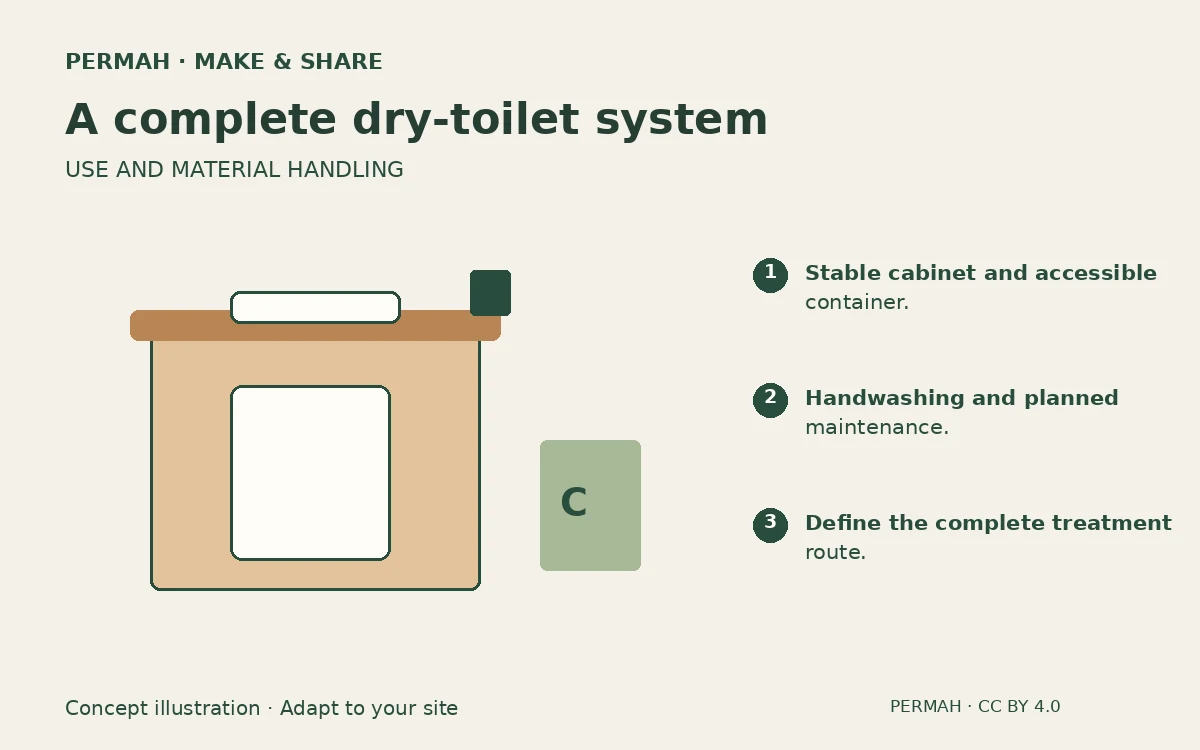
A dry toilet uses no flush water. Litter-based and separating systems need different collection and treatment arrangements. Choose the complete handling chain first; a cabinet alone does not solve waste management.
Prepare the installation
Record users, frequency, accessibility, space, lifting constraints and handwashing access. Provide a suitable removable watertight container, a transport lid, clean carbon material for litter systems and washable surfaces. Follow the selected system's ventilation and connection instructions.
For a cabinet, measure the container and seat before cutting panels. Build a stable structure with spill-free container access. Remove sharp edges and avoid materials with unknown treatments. Test stability with an adult. Dimensions depend on the seat, container and accessibility needs.
Check local requirements
In France, discuss the installation, dedicated material-handling area and remaining household wastewater with the SPANC. The rules include avoiding nuisance, liquid discharge outside the plot and water pollution. Dry toilets do not eliminate treatment needs for kitchen, shower or laundry water. Elsewhere, check local rules.
Maintenance and material handling
Display short instructions, plan cleaning and handwashing, and name who maintains the system. Keep containers closed and children away from emptying work. A compost heap is not automatically sanitised: do not apply a universal waiting period or put fresh material on crops. Define a suitable treatment route and prevent uncontrolled escape into soil or water.
Trial everyday use
Check odour, ergonomics, handling effort and understandable instructions before wider use. In shared housing, agree maintenance duties and a full-container procedure. Design for the people who will actually use it.
Connect the topics
Sources and method
Original Permah guide. Organisational proposals and planning estimates are editorial; the references below document the cited principles. Sources checked on 16 October 2026.
Books to explore further
Descriptions based on publisher listings. Check edition and language before choosing.
Le Guide Terre vivante — Composts & paillages
A guide to organic materials, composting systems and mulching. The publisher describes system choices, their limits and garden uses.
Publisher / author page ↗Search on Amazon ↗
De la maison autonome à l’économie solidaire
A personal account of domestic autonomy and its connections with a cooperative economy; read in its historical context.
Publisher / author page ↗Search on Amazon ↗
L’habitat permacole
A design approach linking housing, resources and territory, with case studies.
Publisher / author page ↗Search on Amazon ↗